

Real Results From Real Projects
Room Lighting & Power Calculator
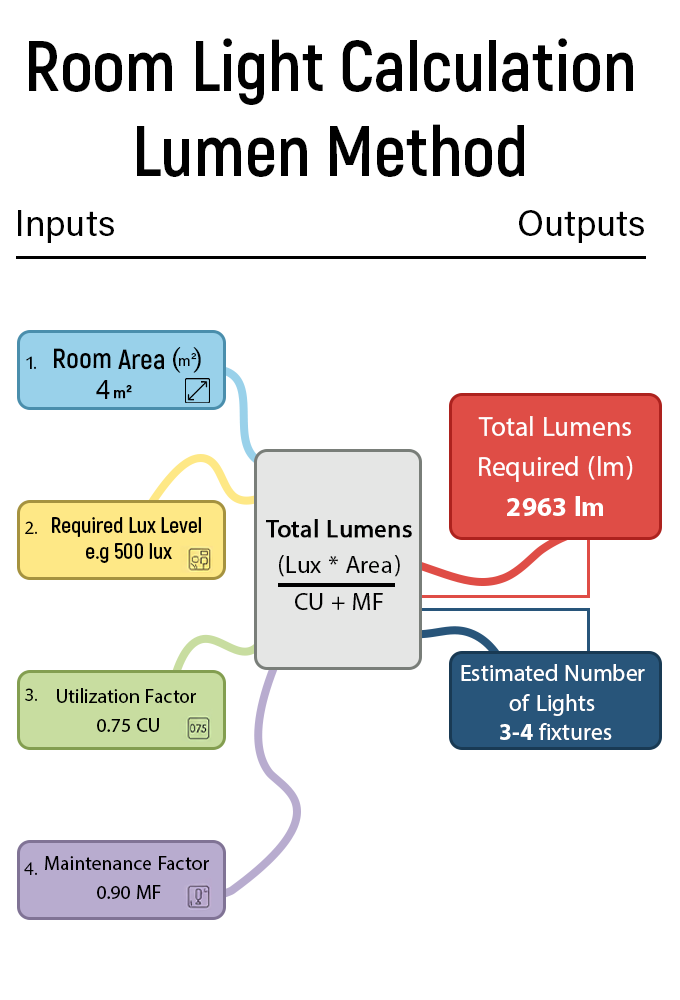
Easily calculate the number of lights, total lumens, and power needed for any room. Enter room size, select required lux, and choose utilization and maintenance factors for accurate lighting planning.
Lighting Requirement Calculator
Light Quantity Calculator
Here you can calculate the number of lights required in a room based on the type and size of room. Enter the room size, select the type and choose a light.
Lux: Lux (Illuminance) is a measurement of the light intensity at any point. It is equal to 1 Lumen per square meter.
Room Type: A small list of typical room types and their recommended illuminance levels. If you require a different room type, please contact us.
Lumens-Lux Calculator
Notes:
Illuminance (lux): Illuminance is a measurement of the light intensity at any point. The light intensity drops exponentially the further away you get from the source (distance).
Luminous Flux (Lm): The luminous flux is a measure of the total light output from a source. For example, a 1 candela light source will product 1 lumen per square meter at the distance of 1 meter.
Beam Angle: The beam angle is the angle of radiation for a light source. For example, a beam angle of 30 degrees means the light has the shape of a cone and its borders form a 15 degree angle with the center axis. A change in the beam angle affects the luminous intensity (lux) of a light source but not the luminous flux (Lumens).
Results: The calculation used is based on the illumination of a flat surface resulting in a higher illuminance in the centre rather than an even distribution of light over the area.
Light Spread Calculator
Here you can calculate the light spread as the diameter of the resulting ‘spot’ of light and the coverage area, from the beam angle and distance to the surface. Enter the distance and beam angle and click ‘Calculate’.
Spread (m): The spread is the width of the light when it hits the flat surface.
Coverage Area (m2): The coverage area is the size of the circular area that the light illuminates on the flat surface.